

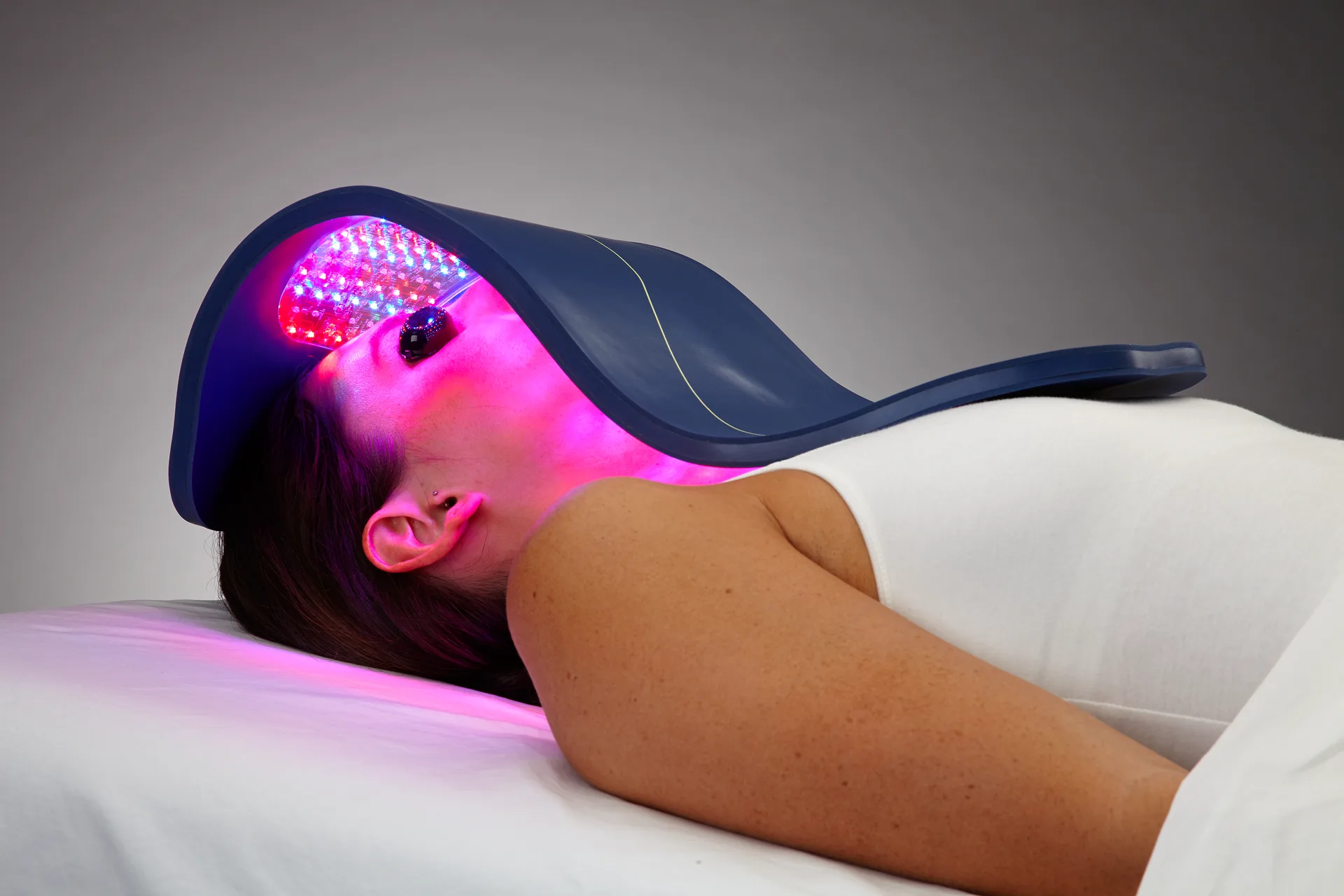
"Does red light therapy actually stimulate collagen, or is that just marketing?"
It is a fair question. The anti-aging skincare industry has a long history of overpromising and a shorter history of being honest about what specific treatments actually do at the cellular level. Red LED light therapy is in an interesting middle ground: the science behind it is solid, the mechanism is well understood, and the results are real, but the gap between the published evidence and the consumer marketing is wide enough to make even careful clients suspicious.
This guide explains the actual mechanism, what red and near-infrared LED can realistically do for aging skin, what they cannot do, and how to plan a series that produces visible change rather than just a relaxing afternoon. It is written by licensed estheticians at our Etobicoke clinic and reflects what we see in real outcomes for Toronto-area clients across a range of ages and skin concerns.
The 30-Second Summary
Red light around 630 to 660 nanometres and near-infrared light around 810 to 830 nanometres are absorbed by an enzyme in skin cell mitochondria called cytochrome c oxidase. That absorption boosts cellular energy (ATP), which upregulates fibroblast activity and increases collagen and elastin synthesis. The effect is real and well-documented, but it is gradual. Expect a same-day glow, subtle improvements by week 3, and meaningful firmness changes after 8 to 12 weeks of consistent sessions. Best as part of a routine that also includes daily SPF, vitamin C, and a retinoid.
The Mechanism: Photobiomodulation Explained Simply
The fancy name for what red LED does is "photobiomodulation". It sounds complex but the core idea is simple. Specific wavelengths of light are absorbed by specific molecules in your cells, and that absorption changes how those molecules behave. With red and near-infrared light, the target molecule is cytochrome c oxidase, an enzyme that sits in the inner membrane of mitochondria, the energy-producing organelles inside every cell.
Here is what happens, step by step:
- Red or near-infrared photons reach the dermis (the layer of skin where fibroblast cells live and produce collagen).
- Those photons are absorbed by cytochrome c oxidase in the mitochondria of skin cells.
- That absorption causes a brief release of nitric oxide, which had been inhibiting the enzyme. With the inhibition lifted, the mitochondria run more efficiently.
- Cellular ATP production increases. ATP is the universal energy currency of cells, and fibroblasts need a lot of it to do their job, including producing collagen and elastin.
- With more available energy, fibroblasts upregulate collagen and elastin synthesis. Over weeks of repeated stimulation, measurable amounts of new collagen accumulate in the dermis.
The nitric oxide release also has a secondary effect: it dilates small blood vessels, which is why you might notice an immediate "glow" after a session. That part is real but short-lived. The collagen-related change is slower and more durable.
Why Red and Near-Infrared Together
Red light around 630 to 660 nanometres penetrates a few millimetres into the skin and is excellent for fibroblast activation in the dermis. Near-infrared light around 810 to 830 nanometres penetrates deeper still, reaching the subcutaneous tissue, and has additional effects on circulation and tissue repair. Most clinical protocols use both wavelengths together because they complement each other. Some panels deliver them simultaneously; others alternate.
Treatment-grade LED panels deliver these wavelengths at a precise dose. The dose matters: too little and the cells do not respond; too much and the effect actually reverses (this is called the biphasic dose response in photobiomodulation literature). Clinical panels are calibrated to the right zone. This is one of the meaningful differences between a professional session and an inexpensive at-home gadget.
What Red LED Can Realistically Do
Within its mechanism, here is what red and near-infrared LED light reliably produce over a series.
Softer Fine Lines
The lines that appear from sun exposure, dehydration, and early collagen loss soften over a series. Crow's feet, fine forehead lines, and superficial lip lines respond best. Deep static wrinkles change less.
Improved Skin Tone and Brightness
The combination of increased microcirculation and active cell turnover produces a brighter, more even-toned look. The change is subtle but consistent over a series and is what most people perceive as "glowing skin".
Subtle Firmness Gains
New collagen production translates into modest firmness improvements, particularly along the cheeks and jawline. Not the same as a surgical lift, but a measurable shift visible in side-by-side photos at 12 weeks.
Calmer Redness and Healing Support
Red LED reduces inflammation and supports recovery after other treatments. It is one of the most useful add-ons to chemical peels, microdermabrasion, or microchanneling sessions, since it speeds healing without any irritation.
What Red LED Cannot Do
Knowing the limits of any treatment is what separates a good plan from a disappointment.
The Honest Limitations
Will Not Significantly Help
- Deep static wrinkles (forehead furrows, nasolabial folds)
- Significant jowl sagging or facial volume loss
- Sun damage that has progressed to thick, leathery skin
- Deep melasma or stubborn pigmentation
- Acne scarring with textural change
- Excess submental fat or "double chin"
What Does Work for Those
- Deep wrinkles: neuromodulators, fillers (medical referral)
- Sagging or volume loss: medical aesthetics referral
- Thick sun damage: medium-depth chemical peels
- Melasma: dermatologist-supervised topicals + gentle peels
- Acne scarring: microchanneling, fractional treatments
- Submental fat: medical referral for non-surgical or surgical options
If your goal sits on the left side of this table, red LED alone will frustrate you. It may still be part of a broader treatment plan, often as a recovery aid after stronger procedures, but it should not be the primary tool.
Realistic Timeline: What to Expect Week by Week
One of the most useful things to set in advance is a realistic timeline. Red LED produces both an immediate effect and a slow cumulative effect, and they are different from each other.
A Typical 12-Week Anti-Aging LED Plan
Day of session: immediate effects
Same-day glow and softer feel from increased microcirculation. Mild warmth during the session. No downtime, makeup is fine afterwards. The immediate effect lasts roughly 24 to 48 hours before settling.
Weeks 1 to 4: loading phase
Two to three sessions per week. Each is 20 to 30 minutes. Skin starts to look more uniformly bright and feels more resilient. Pinkness or sensitivity from other treatments resolves faster than usual.
Weeks 5 to 8: first collagen-related changes
Drop to one session per week. New collagen takes time to accumulate. Subtle improvements in fine lines and a slightly firmer look around the cheeks and jawline. Photos at week 0 versus week 8 in consistent lighting often show the difference more clearly than the mirror.
Weeks 9 to 12: visible cumulative results
One session per week or every 10 days. By the end of the 12 weeks, most clients see softer fine lines, more even tone, and a brighter, firmer look. The change is meaningful but not dramatic, and best maintained with ongoing sessions.
Maintenance phase
One session every 2 to 4 weeks indefinitely. Collagen turnover is ongoing throughout life; the LED keeps the fibroblasts active. Many clients combine an LED session every other week with a quarterly microdermabrasion or chemical peel.
The Home-Care Multiplier
Red LED works dramatically better as part of a coordinated routine than as a standalone treatment. The published research on photobiomodulation almost always assumes clients are also using basic at-home actives. Here is what we recommend for the strongest result.
Morning
- Gentle cleanser. Low-pH, non-stripping.
- Vitamin C serum (10 to 20 percent L-ascorbic acid or a derivative). One of the most evidence-based topical anti-aging ingredients. Antioxidant protection through the day and a co-factor for collagen synthesis. Works synergistically with LED.
- Moisturizer. Hyaluronic acid, ceramides, or peptides depending on your skin.
- SPF 30 or higher, broad-spectrum, every morning, year-round. Non-negotiable. UV damage is the single biggest driver of visible aging in skin. There is no anti-aging treatment that overcomes inconsistent sunscreen use.
Evening
- Same gentle cleanser.
- Retinoid (over-the-counter retinol or prescription retinoid). Increases cell turnover and stimulates collagen through a complementary pathway. Start slow (twice per week) and build tolerance.
- Rich moisturizer. Repair-focused at night.
Timing Around LED Sessions
- Pause retinoids and exfoliating actives (AHAs, BHAs) for 24 hours before and after each LED session.
- Keep vitamin C in your morning routine throughout. Skip the morning of an LED session only if your skin is particularly sensitive.
- Avoid heavy makeup immediately before a session so the light reaches the skin directly.
How Red LED Compares to and Combines with Other Anti-Aging Treatments
Anti-aging is rarely a single-tool job. Each treatment has a specific role. Here is how red LED fits with the other tools we offer at the clinic.
Red LED + Microdermabrasion
Microdermabrasion lifts the dead surface layer and improves product absorption. LED right after benefits from less interference at the surface, and the LED reduces any post-treatment pinkness. A common combination for monthly maintenance. See microdermabrasion.
Red LED + Chemical Peels
LED after a chemical peel speeds healing, reduces redness, and softens the recovery period. The collagen stimulation also reinforces the peel's effect on skin renewal. Best timed in the days following the peel rather than immediately after. See chemical peels.
Red LED + Microchanneling
Microchanneling creates controlled micro-injuries that signal collagen synthesis. Red LED in the days after speeds healing and amplifies the collagen response. A powerful pairing for textural concerns or deeper anti-aging goals. See microchanneling.
Red LED + Galvanic Facial
Galvanic treatment improves product penetration and tightens skin temporarily. LED in the same session amplifies the firmness effect and supports a healthier glow that lasts beyond the day of treatment.
Side Effects, Contraindications, and Safety
Red LED is among the safest professional treatments available. There is no thermal injury, no chemical exposure, and the light is not in the UV range so there is no DNA-damaging or pigmentation-triggering risk. That said, here are the situations where we postpone or avoid the treatment.
- Photosensitizing medications. Some antibiotics (tetracyclines, sulfa drugs), some diuretics, certain antifungals, St. John's wort, and a few others increase the skin's reaction to light. We screen at the consultation.
- Active rosacea flare. Wait until the flare has settled. Red LED is generally good for rosacea-prone skin between flares.
- History of light-sensitive epilepsy. Rare but flag at consultation.
- Active cancer in the treatment area. Wait for medical clearance.
- Pregnancy. Widely considered safe but evidence in pregnancy is limited. Defer to your physician.
- Recent injectables. Wait at least 1 to 2 weeks after Botox or fillers before LED on the same area.
The Honest Verdict: When LED Is Worth It
If you have realistic expectations and you are willing to combine it with home care, red LED is one of the better-value anti-aging treatments available. It is gentle, low-risk, has zero downtime, and produces measurable change over a series. It is particularly good if you cannot tolerate aggressive treatments, you have sensitive or rosacea-prone skin, or you want maintenance between bigger procedures.
If your expectation is to look ten years younger after a single session, or to erase deep wrinkles that have settled over decades, LED will frustrate you. Set the timeline correctly and the result will exceed what most clients expect; set it incorrectly and even a good outcome will look small. Twelve weeks of consistent sessions, paired with vitamin C, retinoid, and SPF, is what produces the result you can see in photographs.
Ready to Build Your Anti-Aging Plan?
If you want to start a 12-week red LED series and stack it with the right home care: book an LED light therapy session. Bring your current skincare routine to the consultation so we can advise where to adjust.
If your goal is broader, our other anti-aging options are microchanneling for collagen stimulation through controlled micro-injury, chemical peels for deeper resurfacing, and microdermabrasion for ongoing surface refinement. Many of our long-term clients combine all of these on a planned schedule. For tackling acne-related concerns first, see our guide to blue LED therapy.
Frequently Asked Questions
Yes. Red light around 630 to 660 nanometres and near-infrared light around 810 to 830 nanometres are absorbed by cytochrome c oxidase in mitochondria. This boosts ATP production in skin cells, which upregulates fibroblast activity and increases collagen and elastin synthesis over a series of sessions. The effect is real but gradual: measurable changes typically appear after 4 to 8 weeks of consistent treatment.
Professional panels deliver a higher and more precisely targeted dose of light energy, with the entire face evenly exposed at the correct distance. At-home masks vary widely in output and wavelength accuracy. Some good consumer masks help as maintenance, but they generally do not match the cumulative effect of a clinic series, particularly in the first weeks of treatment.
Most clients notice a same-day glow and softer feel after the first session, but those are immediate circulation effects. Genuine collagen-related changes take time. Typically: subtle improvement at week 2 to 3, more visible firmness at week 6 to 8, and the most noticeable results from a complete 12-week series. Photographs at week 0 and week 12 help track the progress objectively.
Yes, and you should. The combination of a daily vitamin C in the morning and a retinoid at night plus LED sessions in clinic is the gold standard at-home complement to professional anti-aging treatment. Pause exfoliating actives (AHAs, BHAs, retinoids) for 24 hours before and after each LED session to avoid stacking irritation.
Red LED helps soften the look of fine lines, improves overall skin firmness slightly, and supports better tone. It does not address deeper static wrinkles, significant jowls, or volume loss. For those concerns, microchanneling, chemical peels, or medical aesthetic referral is usually a better starting point. LED can still be a useful adjunct alongside those treatments.
Side effects are minimal. Brief, mild warmth or pinkness during the session that resolves within minutes. No downtime, no peeling. Photosensitizing medications, active rosacea flares, and a history of light-sensitive epilepsy are the main reasons we postpone treatment. We screen for all of these at the consultation.