

"Will microdermabrasion get rid of my acne scars and dark spots?"
It is the single most common question we hear from clients in Toronto and across the GTA who are dealing with skin that healed badly after a difficult acne phase. The answer is more nuanced than the marketing suggests, and getting it right matters because the wrong treatment can cost you months of effort and sometimes make things worse.
This guide is the honest version. It explains the difference between a "dark spot", a "post-acne mark", and a true scar, because they are not the same thing and they do not respond to the same treatment. It tells you what microdermabrasion can realistically do, what it cannot do, and what to combine it with for the best outcome. It is written by licensed estheticians at our Etobicoke clinic, drawing on what we actually see work for clients with Toronto-area skin types.
Why Honesty Matters Before You Book
The aesthetics industry overpromises on acne scars and pigmentation more than almost any other category. If a treatment claims to "completely erase" deep scars in a few sessions, it is not telling you the truth. The reality: most skin discolouration after acne fades meaningfully with the right plan, but true textural scars need more than surface exfoliation. Knowing the difference saves you money and disappointment.
Acne Mark or Acne Scar? The Distinction That Determines Your Treatment
The first thing to know is that most of what people call "acne scars" are not actually scars at all. They are flat discolouration left behind after the breakout healed. True scars involve a textural change in the skin, meaning the surface is no longer smooth. The treatment plan is completely different depending on which one you have.
Run your finger gently across the affected area in good lighting. If the skin feels flat and only the colour is different, you have a mark, not a scar. If you can feel a dip, a pit, or a bumpy ridge, you have a true scar. Most clients with "acne scarring" actually have a mix of both, plus active or recently active breakouts on top.
Type 1: Post-Inflammatory Hyperpigmentation (PIH)
PIH is the brown, tan, or grey-purple flat spot left after a breakout heals. It is the result of melanin overproduction triggered by the inflammation from the acne lesion. It is more common and more persistent in melanin-rich skin, including South Asian, East Asian, Middle Eastern, Black, and Latin skin tones, which is highly relevant for Toronto's diverse population.
PIH is not a scar. It is excess pigment in skin that healed structurally fine. It can fade on its own over 6 to 24 months, but you can speed it up significantly with the right routine. This is where microdermabrasion actually shines.
Type 2: Post-Inflammatory Erythema (PIE)
PIE is the flat pink, red, or purple mark left after a breakout. It is caused by damaged or dilated capillaries in the area where the lesion was. PIE is more common in lighter skin tones (Fitzpatrick I to III). Like PIH, it is not a scar. PIE responds slowly to topical care and can take 12 to 18 months to resolve on its own.
Microdermabrasion has a smaller effect on PIE than on PIH because the redness comes from blood vessels rather than surface pigment. LED light therapy (yellow or red wavelengths) is often the more direct treatment.
Type 3: True Acne Scars (Textural)
True scars come in three common shapes:
- Ice pick scars: narrow, deep pits, like the skin was punctured with a fine tool. Usually on the cheeks and temples.
- Boxcar scars: wider, rectangular indentations with sharp edges, often on the cheeks. Can be shallow or deep.
- Rolling scars: shallow, soft-edged depressions that give the skin a wavy or undulating look, especially in raking light.
There is also a fourth, less common type: hypertrophic and keloid scars, which are raised rather than depressed. These tend to appear on the jawline, chest, and back, and need very different management (often medical referral).
What Microdermabrasion Can Realistically Do
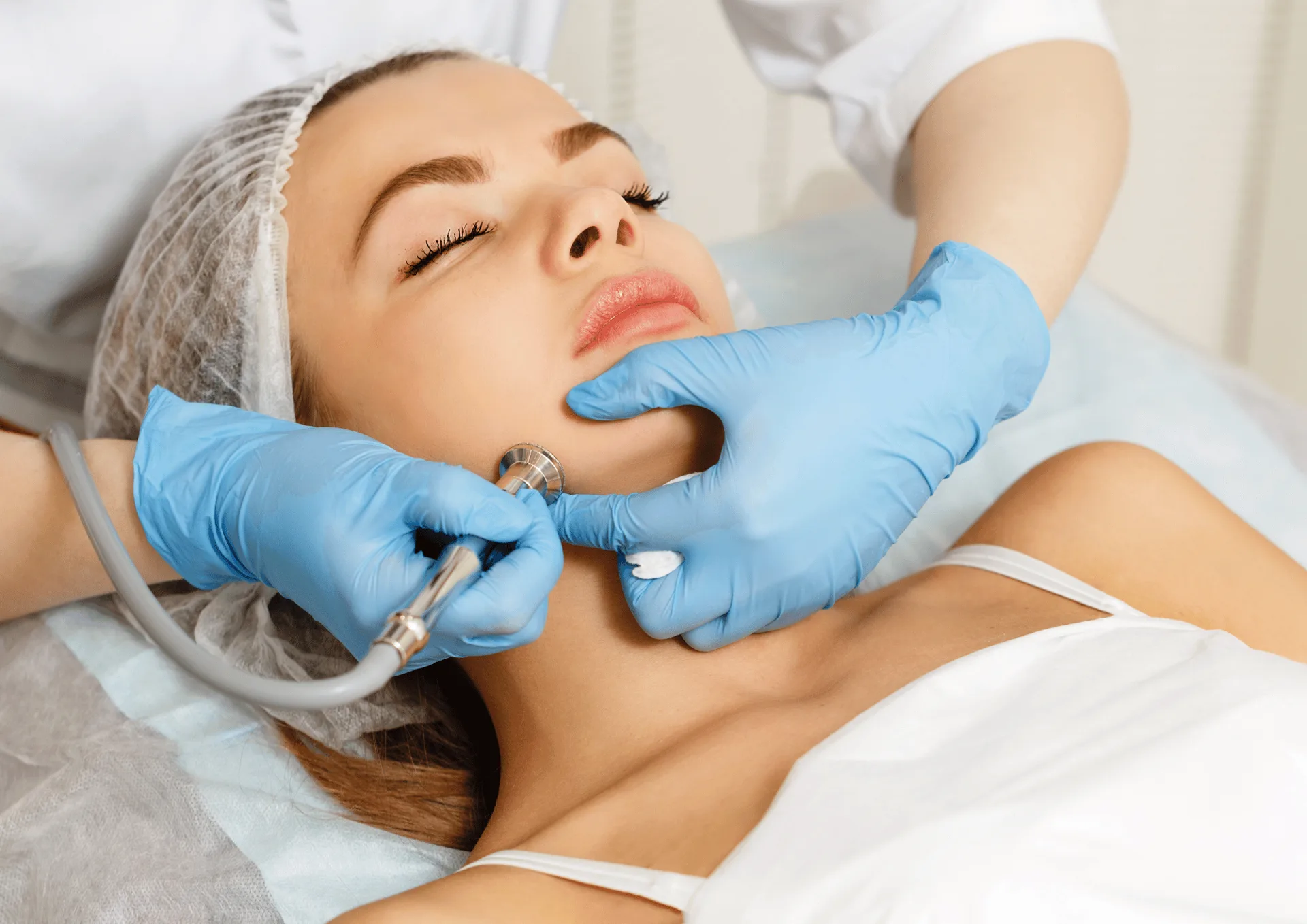
Microdermabrasion is mechanical exfoliation. A diamond-tipped wand and vacuum suction lift away the outermost layer of dead cells. That is the entire mechanism. It does not penetrate into the dermis, it does not stimulate significant new collagen at depth, and it does not affect melanocytes (the pigment-producing cells) directly.
Within those limits, here is what it does well:
Fades Surface PIH
The melanin that creates dark marks sits partly in the upper skin layers. Repeated mechanical exfoliation accelerates the natural shedding of pigment-laden cells, which speeds visible fading of post-acne dark marks over a series of sessions.
Softens Very Shallow Rolling Scars
The mildest rolling scars can look smoother after a microdermabrasion series because the surrounding surface is more even. The scar is not removed, but the contrast becomes less obvious in normal lighting.
Brightens Overall Tone
Removing dead cells lifts dullness across the face, which makes individual dark marks look less prominent. The marks themselves fade slower than the overall tone improves, so you see contrast change before colour change.
Smooths Texture Around Scars
If you have post-acne texture (small bumps, mild congestion, uneven feel) mixed in with marks or scars, microdermabrasion smooths the texture and makes the marks easier to address with follow-up treatments.
The key word in all of this is "series". A single microdermabrasion will not fade pigmentation. Four to six sessions, spaced 2 to 4 weeks apart, paired with the right home routine, is the realistic minimum to see meaningful change in PIH.
What Microdermabrasion Cannot Do
This is the part the industry tends to skip. Knowing the limits helps you avoid wasting time and money on the wrong treatment.
The Honest List of Limitations
Will Not Fix
- Ice pick scars (narrow, deep pits)
- Deep boxcar scars with sharp edges
- Hypertrophic or keloid raised scars
- Melasma (deeper, dermis-level pigmentation)
- Active acne or current breakouts
- Dilated capillaries or rosacea-related redness
What Does Work for Those
- Ice pick / boxcar scars: microchanneling, fractional laser, TCA cross
- Deep boxcar scars: chemical peels (medium depth) + microchanneling
- Hypertrophic / keloid: medical dermatology referral
- Melasma: prescription topicals + light chemical peels + strict SPF
- Active acne: salicylic peels, LED blue light, topical regimen
- Capillaries / rosacea redness: LED yellow / red light, IPL (referral)
If your concern is on the left column, microdermabrasion alone is the wrong starting point. You may still benefit from microdermabrasion as a maintenance treatment alongside the more targeted therapy, but it should not be your primary plan.
Building a Realistic Series for Post-Acne Marks
Here is what we typically recommend for someone whose main concern is PIH (the brown / dark flat marks from healed acne). This assumes no active breakouts, no recent isotretinoin (Accutane) use, and a skin tone that has been assessed for safe intensity.
A 12-Week PIH Fading Plan
Weeks 1, 3, 5, 7, 9, 11: Microdermabrasion sessions
Six sessions spaced 2 weeks apart. The 2-week gap lets the new skin layer settle and any pinkness fully resolve before the next session.
Daily SPF 30+ broad-spectrum sunscreen
Non-negotiable. Pigmentation that is being lifted comes back faster than it fades if the skin keeps getting hit by UV. This applies in Toronto winters too, especially with snow glare.
Nightly tyrosinase-inhibiting actives
Vitamin C in the morning. At night, an azelaic acid, niacinamide, or alpha arbutin serum to slow melanocyte activity. Skip on the night before and the night of a microdermabrasion session.
Pause exfoliating actives 3 days before and after sessions
Hold retinoids, AHAs, BHAs, and exfoliating scrubs for 72 hours on either side of each appointment to avoid over-exfoliation.
Reassess at week 12
By the end of the series, most clients see 40 to 70 percent fading of surface PIH. The remaining marks either need more time (slow continued home routine) or a different treatment (chemical peel or microchanneling) to push further.
This is a realistic plan, not an aggressive one. Aggressive plans (weekly microdermabrasion, stacked with strong actives) tend to backfire by triggering more inflammation, which causes more PIH in the very skin you are trying to clear. The "slow and steady" approach wins for pigmentation.
Skin Tone Matters: Considerations for Melanin-Rich Skin
Toronto and the GTA have one of the most diverse populations in North America. Our clinic regularly treats clients across the full Fitzpatrick scale, from Northern European skin (I to II) to South Asian, East Asian, Middle Eastern, African, and Caribbean skin (IV to VI). The way pigmentation behaves is fundamentally different in different skin tones, and treatments need to adapt.
Why PIH Is Worse in Darker Skin
Melanin-rich skin produces more melanin in response to inflammation. That is the same trait that gives natural sun protection, but it is also why an acne lesion that would heal cleanly in lighter skin can leave a months-long dark mark in deeper skin. PIH is one of the most common reasons clients with skin types IV to VI seek out esthetician care.
What This Means for Treatment Choice
The risk to manage carefully in darker skin tones is treatment-induced hyperpigmentation, where an aggressive treatment causes new pigmentation in the very skin that came in to lighten existing pigmentation. This is why:
- Microdermabrasion is generally safer than aggressive chemical peels or ablative lasers in melanin-rich skin. The risk of triggering new PIH is lower because there is no chemical injury and no deep mechanical injury, just surface exfoliation.
- Intensity must still be calibrated. An esthetician who treats darker skin regularly will use lighter pressure and shorter passes. Multiple lighter sessions beat one aggressive session every time for darker skin.
- Sun protection becomes even more important. Melanin-rich skin is at higher risk of new pigmentation if treated skin gets significant UV exposure within 4 to 6 weeks after the session.
If you have skin type IV to VI and you have been turned away from peel-based treatments at other clinics, microdermabrasion is often a safer entry point. Our estheticians assess Fitzpatrick type at the first consultation and tailor pressure and intensity accordingly.
When Microdermabrasion Is Not Enough: Other Options at Anagenesis
If your concern is mostly textural scarring, melasma, or deeper pigmentation, microdermabrasion is part of the plan but not the whole plan. Here is what we typically combine it with, depending on the concern.
For Rolling and Mild Boxcar Scars
Microchanneling creates controlled micro-injuries that stimulate collagen at depth, smoothing the floor of the scar over a series. Microdermabrasion can be added 4 weeks after each microchanneling session for surface refinement. See our microchanneling page for details.
For Stubborn Pigmentation
Chemical peels reach deeper pigmentation that microdermabrasion misses. A light glycolic or mandelic acid peel paired with microdermabrasion 4 weeks later is a common combination. Our peel vs microdermabrasion guide walks through the choice in detail.
For Active Acne and PIE
LED light therapy with blue wavelengths targets acne bacteria and reduces inflammation, while red and yellow wavelengths support healing and fade redness. LED is gentle enough to use during active breakouts when microdermabrasion is not appropriate. See LED light therapy.
For Melasma
Melasma is the most complex pigmentation concern and needs the most cautious plan. It involves topical prescription therapy (referral), strict daily SPF, very gentle chemical exfoliation, and time. Microdermabrasion can be part of maintenance once melasma is stable but is not a primary treatment.
A Worked Example: Maya, 28, in Mississauga
To make this concrete, here is a composite example based on real client patterns we see at our Etobicoke clinic. Names and details are anonymised.
Maya, 28, lives in Mississauga and works in finance in downtown Toronto. After a tough winter with mask-related breakouts and stress, she has flat brown post-acne marks scattered across her cheeks. Her skin type is Fitzpatrick IV. She has no textural scars, no active acne (her breakouts cleared 6 weeks before her consultation), and no melasma history. Her current skincare routine is a basic cleanser, moisturizer, and inconsistent sunscreen use.
Her Plan
Her esthetician sets up a 12-week plan:
- Home routine first, sessions second. Week 1 begins with a corrected home routine: daily SPF 50, vitamin C serum every morning, niacinamide 10 percent every evening. No new treatments yet.
- First microdermabrasion at week 2, after she has had 1 week of consistent SPF and home actives. Pressure set conservatively for Fitzpatrick IV skin.
- Sessions every 2 weeks for 6 sessions total (weeks 2, 4, 6, 8, 10, 12).
- 72-hour active pause on either side of each session: she stops the vitamin C and niacinamide for 3 days before and 3 days after.
- Weekly check-in photos in consistent lighting to track real progress.
The Outcome
By week 6, the most prominent dark marks have faded by about 30 percent. By week 12, fading is in the 50 to 60 percent range. Her overall tone is noticeably more even and her skin reflects light better. The remaining marks are predicted to continue fading over the following 3 to 6 months with the home routine alone. She is moved to a maintenance schedule of one microdermabrasion every 8 weeks.
If her dark marks had been deeper, the plan would have included one or two light chemical peels at week 4 and week 8 to push pigmentation that microdermabrasion alone could not reach. If her concerns had been textural scars, microchanneling would have been the primary treatment with microdermabrasion as a refinement step.
Honest Deal-Breakers: When We Refer You Elsewhere
An esthetician's job includes knowing when something is outside our scope. Here is when we will refer you to a dermatologist or another provider rather than book you for microdermabrasion.
- Severe active acne. If you have cystic or nodular acne, you need medical treatment first. Topical or oral therapy from a dermatologist gives a much faster, safer path forward than any spa facial.
- Suspected melasma without diagnosis. Melasma should be diagnosed and managed under medical supervision because the treatment options are nuanced and the wrong move makes it worse.
- Hypertrophic or keloid scars. Raised acne scars need medical management (intralesional steroids, silicone therapy, sometimes referral to a plastic surgeon).
- Currently or recently on Accutane. Isotretinoin makes the skin too fragile for exfoliating treatments for 6 to 12 months after the last dose, depending on the dose taken.
- Pigmented lesions you have not had checked. If a "dark spot" has changed in size, shape, or colour, or is irregular, it should be assessed by a doctor before any treatment.
If anything on this list applies to you, we are happy to do a free consultation to point you in the right direction.
Toronto-Specific Timing: When to Start Your Series
The seasonal angle matters more for pigmentation than for any other skin concern. Pigmentation treatments work by lifting melanin to the surface so it sheds. If the new skin underneath gets hit by strong UV before it has fully matured, you can trigger new pigmentation and lose ground.
In Toronto and the GTA, the best window for a pigmentation-focused microdermabrasion series is late September through April. A 12-week series started in late September wraps before the long days of May and June. A series started in mid-December finishes by early March. A series started in mid-April still works, but you need to be especially strict with daily SPF and consider avoiding outdoor lunch breaks during the strongest UV hours.
Summer is not a complete write-off for microdermabrasion, but it is the worst window for starting a pigmentation series. If you want a single refresh in June or July, that is fine. A multi-session pigmentation push is better postponed until fall.
Ready to Build Your Plan?
If you have post-acne marks or surface pigmentation and want to start a structured series, book a microdermabrasion consultation. Bring photos of your skin over the last 6 months if you have them, it helps us understand what is fading on its own and what is stuck.
If you are not sure whether your concern is PIH, PIE, or true scarring, the consultation is the right starting point. We will examine your skin in person, assess Fitzpatrick type, ask about your history, and recommend a plan that may include microdermabrasion alone, microdermabrasion combined with a chemical peel series, microchanneling, LED light therapy, or a referral if that serves you better.
Frequently Asked Questions
Microdermabrasion can soften the look of very shallow rolling scars and surface texture changes, but it cannot remove true acne scars like ice pick or deep boxcar scars. For deeper scarring, microchanneling, chemical peels, or fractional treatments are more effective. Microdermabrasion does work well for the flat dark or red marks left behind after acne heals, which are often confused with scarring.
Most clients see noticeable fading of surface dark spots after 3 to 4 sessions spaced 2 to 4 weeks apart. Deeper pigmentation may need 6 or more sessions combined with a daily SPF and tyrosinase-inhibiting actives at home. Pigmentation that does not respond after 4 sessions likely sits deeper and needs a different treatment approach.
Microdermabrasion alone is not the right treatment for melasma. Melasma is a complex, dermis-level pigmentation condition that requires specific topical therapy, strict sun protection, and often chemical peels or low-energy laser treatments under professional guidance. Aggressive mechanical exfoliation can sometimes worsen melasma. Always disclose a melasma history at consultation.
Microdermabrasion is generally safer for melanin-rich skin than aggressive chemical peels or ablative lasers because it does not create deep injury that can trigger post-inflammatory hyperpigmentation. However, pressure and intensity must be calibrated carefully. An experienced esthetician should always assess Fitzpatrick skin type and adjust the treatment accordingly.
We do not perform microdermabrasion over active acne breakouts. The vacuum and physical exfoliation can spread bacteria and trigger more inflammation. Wait for active breakouts to settle, then microdermabrasion is a good option for the marks left behind. For active acne, LED light therapy with blue wavelengths or a salicylic-based chemical peel are better starting points.
Fall through early spring is the ideal window in Toronto and the GTA. Reduced UV exposure during these months gives the freshly exfoliated skin a chance to heal without triggering new pigmentation. A series started in late September can be complete before the strong summer sun returns in May.